
Introduction
As the demand for faster, more reliable, and energy-efficient communication continues to grow, Ethernet has evolved far beyond its traditional role in computer networking. Today, it is one of the most important communication technologies integrated into modern VLSI chips and System-on-Chip (SoC) designs. Whether it is powering cloud data centers, enabling autonomous vehicles, supporting industrial automation, or connecting billions of IoT devices, Ethernet serves as the backbone for high-speed data exchange.
Integrating an Ethernet controller directly into an SoC allows designers to achieve lower latency, higher throughput, improved power efficiency, and reduced system complexity. However, designing a standards-compliant Ethernet IP that delivers gigabit-level performance while meeting stringent area, power, and timing constraints is a significant engineering challenge. This case study explores the architecture, design challenges, optimization techniques, and real-world applications of Ethernet in modern VLSI systems.
Why Ethernet Matters in VLSI Design
Modern electronic systems generate and process enormous volumes of data. Applications such as AI accelerators, edge computing platforms, automotive electronics, surveillance systems, and industrial controllers require fast and deterministic communication between devices.
Ethernet has become the preferred communication protocol because it offers:
- High bandwidth ranging from 10 Mbps to multi-Gigabit Ethernet
- Standardized communication based on IEEE 802.3 specifications
- Excellent interoperability across vendors
- High reliability with built-in error detection
- Scalability for future bandwidth requirements
- Cost-effective implementation across diverse applications
These advantages have made Ethernet one of the most widely integrated communication interfaces in semiconductor devices.
Ethernet Architecture Inside an SoC
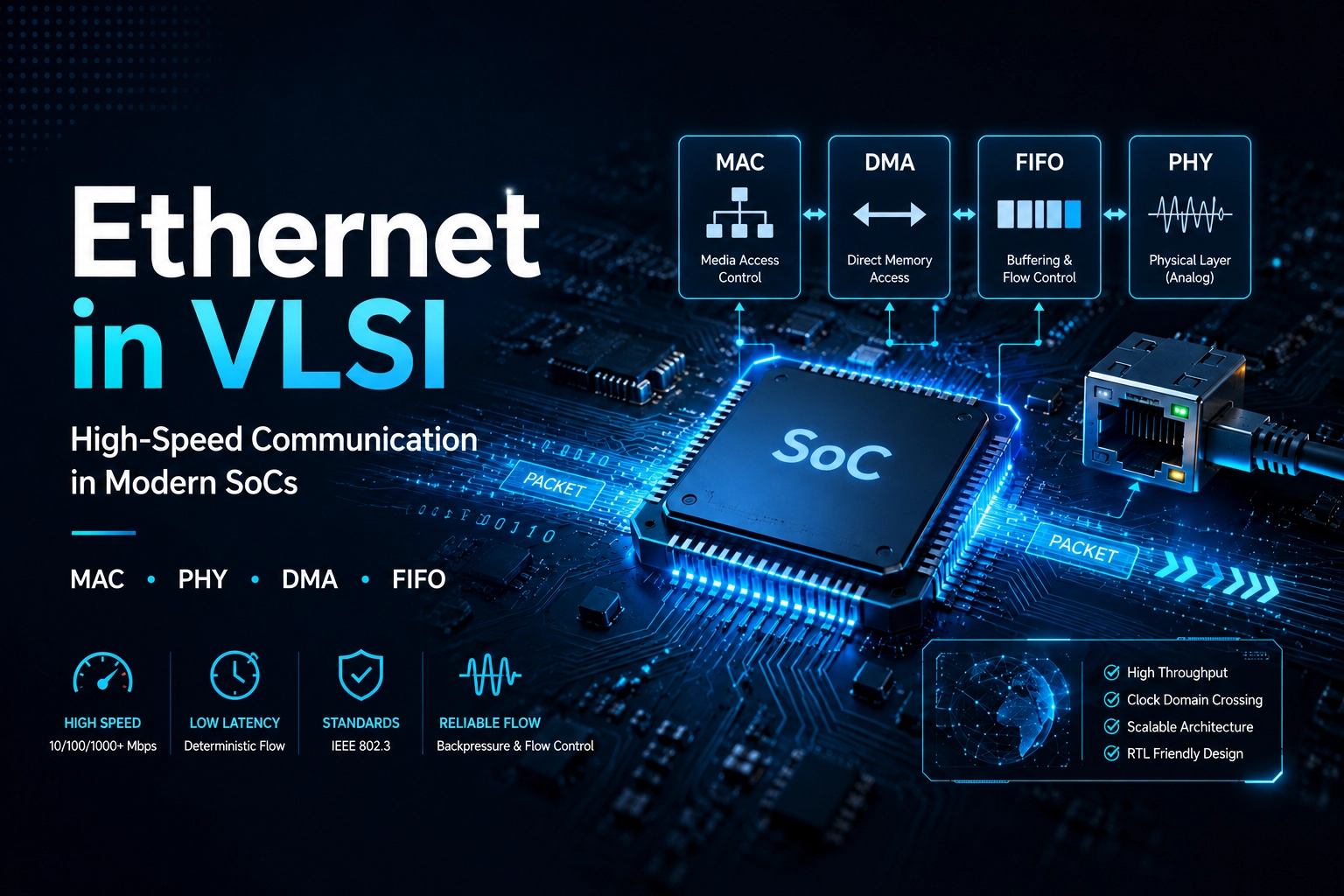
A typical Ethernet subsystem consists of multiple hardware blocks that work together to transmit and receive data efficiently.
1. Media Access Control (MAC)
The Media Access Control (MAC) layer forms the heart of the Ethernet controller. It is responsible for handling packet formatting and communication with higher-level protocols while maintaining compliance with Ethernet standards.
Key responsibilities include:
- Ethernet frame generation
- Frame reception and validation
- Source and destination MAC address handling
- CRC generation and verification
- Frame padding
- Address filtering
- Flow control
- Collision handling (for half-duplex operation)
- Interface management with the PHY
Since the MAC performs operations on every transmitted and received packet, it must be carefully optimized for both speed and silicon efficiency.
2. Physical Layer (PHY)
The Physical Layer (PHY) bridges the gap between the digital logic inside the chip and the external communication medium.
Its primary functions include:
- Digital-to-analog signal conversion
- Analog-to-digital conversion
- Clock recovery
- Signal encoding and decoding
- Line equalization
- Auto-negotiation
- Link detection
- Speed selection
Depending on the application, the PHY may support:
- Twisted pair Ethernet
- Fiber optic communication
- Automotive Ethernet
- Industrial Ethernet
While some SoCs integrate the PHY on-chip, many designs connect to an external PHY through interfaces such as MII, RMII, GMII, or RGMII.
3. DMA Controller
High-speed Ethernet communication would quickly overwhelm the processor if every packet transfer required CPU intervention.
To address this challenge, Ethernet controllers incorporate a Direct Memory Access (DMA) engine.
The DMA controller:
- Transfers packets directly between memory and the MAC
- Minimizes processor overhead
- Enables zero-copy packet movement
- Supports scatter-gather operations
- Maximizes throughput
- Reduces system latency
Efficient DMA architecture is essential for sustaining Gigabit Ethernet performance.
4. FIFO Buffers
Ethernet communication often involves multiple clock domains operating at different frequencies. FIFO buffers help absorb timing variations and maintain continuous data flow.
FIFO buffers provide:
- Temporary packet storage
- Clock-domain isolation
- Burst traffic handling
- Prevention of packet loss
- Smooth data streaming
Asynchronous FIFOs are commonly used to safely transfer data across different clock domains while preventing metastability issues.
Major Design Challenges
Designing an Ethernet MAC for modern semiconductor devices involves balancing performance, power, silicon area, and reliability.
1. Achieving High Throughput
Today’s applications demand support for multiple Ethernet speeds including:
- 10 Mbps
- 100 Mbps
- 1 Gbps
- 2.5 Gbps
- 5 Gbps
- 10 Gbps and beyond
Processing packets at these speeds requires highly optimized RTL architectures capable of handling data continuously without bottlenecks.
2. Timing Closure
Ethernet controllers operate under stringent timing requirements.
Critical datapaths such as:
- CRC computation
- Packet parsing
- DMA interfaces
- FIFO management
- MAC pipelines
must satisfy setup and hold constraints across multiple clock domains while maintaining high operating frequencies.
Achieving timing closure often requires architectural refinements rather than simply increasing synthesis effort.
3. Power Optimization
Power consumption is a primary concern in battery-powered devices, automotive electronics, and edge computing platforms.
Engineers employ several techniques to reduce dynamic and static power:
- Clock gating
- Power gating
- Operand isolation
- Low-power state machines
- Dynamic voltage and frequency scaling (DVFS)
The goal is to reduce power without sacrificing network performance.
4. Silicon Area Optimization
Ethernet IP is frequently integrated alongside CPUs, GPUs, AI accelerators, memory controllers, and security engines.
Reducing silicon area allows designers to:
- Lower manufacturing costs
- Improve chip yield
- Increase integration density
Area optimization focuses on efficient buffer sizing, shared hardware resources, optimized state machines, and streamlined datapaths.
5. Reliability and Data Integrity
Ethernet communication must remain reliable even under noisy operating environments.
The controller incorporates several mechanisms including:
- CRC generation
- CRC verification
- Packet length validation
- Error detection
- Flow control
- Buffer overflow protection
These features ensure that corrupted packets are detected and discarded before reaching higher software layers.
Advanced RTL Optimization Techniques
Modern Ethernet IP employs several architectural enhancements to maximize performance.
1. Deep Pipelining
Pipeline stages divide packet processing into smaller operations, allowing multiple packets to be processed simultaneously.
Benefits include:
- Higher clock frequency
- Increased throughput
- Improved timing closure
- Better resource utilization
Asynchronous FIFOs
Since different portions of the Ethernet subsystem often operate under independent clocks, asynchronous FIFOs safely transfer data across clock domains while minimizing metastability risks.
1. Efficient Buffer Management
Sophisticated buffer management enables continuous packet reception and transmission.
Techniques include:
- Ring buffers
- Descriptor-based DMA
- Double buffering
- Circular FIFOs
- Packet queue optimization
These approaches prevent packet loss during periods of heavy network traffic.
2. Optimized CRC Hardware
CRC computation is one of the most frequently executed operations in an Ethernet controller.
Instead of serial computation, designers often implement:
- Parallel CRC generators
- Hardware polynomial optimization
- Pipeline CRC computation
These improvements significantly reduce processing latency.
Clock Gating
Clock gating disables inactive logic blocks, dramatically reducing dynamic power consumption.
This technique is especially effective in embedded devices where Ethernet traffic may be intermittent.
Compliance with IEEE 802.3 Standards
Every Ethernet controller must conform to IEEE 802.3 specifications to ensure interoperability with networking equipment from different vendors.
Compliance includes support for:
- Standard Ethernet frame formats
- MAC addressing
- CRC generation
- Flow control mechanisms
- Auto-negotiation
- Speed compatibility
- Interface standards
- Error handling protocols
Rigorous verification and compliance testing ensure reliable operation across diverse networking environments.
Real-World Applications
Ethernet IP has become an essential component across a wide range of industries.
Networking Equipment
Enterprise routers, Ethernet switches, and Network Interface Cards (NICs) rely on high-performance Ethernet controllers to sustain continuous high-bandwidth traffic.
Data Centers
Servers and storage systems depend on Ethernet for high-speed communication between processors, storage devices, and cloud infrastructure.
Automotive Electronics
Modern vehicles integrate Automotive Ethernet into Electronic Control Units (ECUs) for applications such as Advanced Driver Assistance Systems (ADAS), infotainment, autonomous driving, and in-vehicle networking.
Industrial Automation
Industrial Ethernet powers Programmable Logic Controllers (PLCs), robotics, factory automation systems, and real-time monitoring equipment where deterministic communication is essential.
Embedded Systems
Embedded processors and SoCs in smart appliances, surveillance systems, and communication devices use Ethernet for reliable wired connectivity.
Internet of Things (IoT)
Many IoT gateways, edge computing devices, and smart city infrastructures employ Ethernet to provide secure, low-latency communication for connected sensors and control systems.
The Future of Ethernet in Semiconductor Design
Networking technology continues to evolve rapidly as applications demand ever-increasing bandwidth and lower latency. Emerging technologies such as AI, autonomous systems, cloud computing, 5G, and Industry 4.0 are pushing Ethernet beyond traditional Gigabit speeds toward multi-Gigabit and Terabit communication.
Future Ethernet IP designs will increasingly incorporate:
- Higher-speed interfaces
- Enhanced hardware acceleration
- AI-assisted traffic management
- Time-Sensitive Networking (TSN)
- Improved security features
- Advanced power management
- Greater integration with heterogeneous SoCs
These advancements will enable next-generation semiconductor devices to meet the growing demands of intelligent, connected systems.
Conclusion
Ethernet has become far more than a networking protocol—it is a foundational technology in modern VLSI and SoC design. By integrating a well-architected Ethernet controller, semiconductor designers can deliver high-speed, low-latency, and standards-compliant communication while optimizing silicon area, power consumption, and overall system performance.
From enterprise networking and cloud infrastructure to automotive electronics, industrial automation, and IoT, Ethernet continues to drive innovation across virtually every sector of the electronics industry. As bandwidth requirements continue to rise, efficient Ethernet IP design will remain a key enabler of next-generation semiconductor solutions, ensuring robust connectivity, scalability, and reliable communication for years to come.
Looking to scope an Ethernet-enabled SoC or embedded design? Book a discovery call with the PQ Angels team.
