

Cache Coherence Verification: What It Is, Why It Breaks, and How to Test It
Cache coherence verification is the process of checking that every core in a multi-core chip sees the same, correct value for shared data, even when several cores hold their own cached copy of it. Modern processors give each core its own local cache so it doesn’t have to wait on slow main memory for every read and write. That speeds things up, but it also means the same piece of data can exist in more than one place at once. If Core 0 changes a value and Core 1 keeps reading its own stale copy, the chip produces wrong results, and those bugs are some of the hardest to catch before silicon. This guide walks through how cache coherence works, the protocols behind it, and what a verification plan needs to cover so this class of bug doesn’t reach tape-out.
What Is Cache Coherence, and Why Do Multi-Core Chips Need It?
Cache coherence is the set of rules that keep multiple caches in a system showing a consistent view of the same memory location. Without it, a multi-core chip could quietly produce two different answers for the same variable depending on which core asked for it.
Here’s the underlying problem. If every core talked to main memory directly, there would be nothing to keep track of, but main memory is far slower than a CPU core, so every processor gets its own cache sitting between it and memory:
CPU → Cache → Main Memory
That cache cuts the wait time on memory access sharply, but now several caches can hold a copy of the same address at the same time. Once one core writes to its copy, the system needs a mechanism that stops other cores from acting on an outdated value. That mechanism is a cache coherence protocol, and getting it wrong is one of the more expensive mistakes a design team can make, because coherence bugs tend to show up as rare, timing-dependent failures rather than something a simple directed test catches on the first pass.
Cache Coherence vs Cache Consistency: Two Different Questions
Engineers new to multi-core design often mix these two terms up, and it’s worth separating them early because a verification plan treats them differently.
Cache coherence is about whether all cores eventually see the correct, up-to-date value for a given memory location. It’s a per-address guarantee.
Memory consistency is about the order in which memory operations, across different addresses, get observed by different processors. A system can be fully coherent and still allow surprising reordering of operations across addresses unless the consistency model rules that out.
Put simply, coherence is about correctness at a single address. Consistency is about ordering across the whole memory system. Most coherence verification work focuses on the first question, but a full memory subsystem sign-off needs both checked, because a design can pass every coherence test and still fail a consistency check if instructions get reordered in a way software doesn’t expect.
How Cache Coherence Works: Coherence Protocols
A coherence protocol tracks the state of every cache line and defines what happens when a core reads or writes it. The best-known protocol is MESI, and most commercial coherence schemes are built on it or a close variant.
The MESI Protocol, State by State
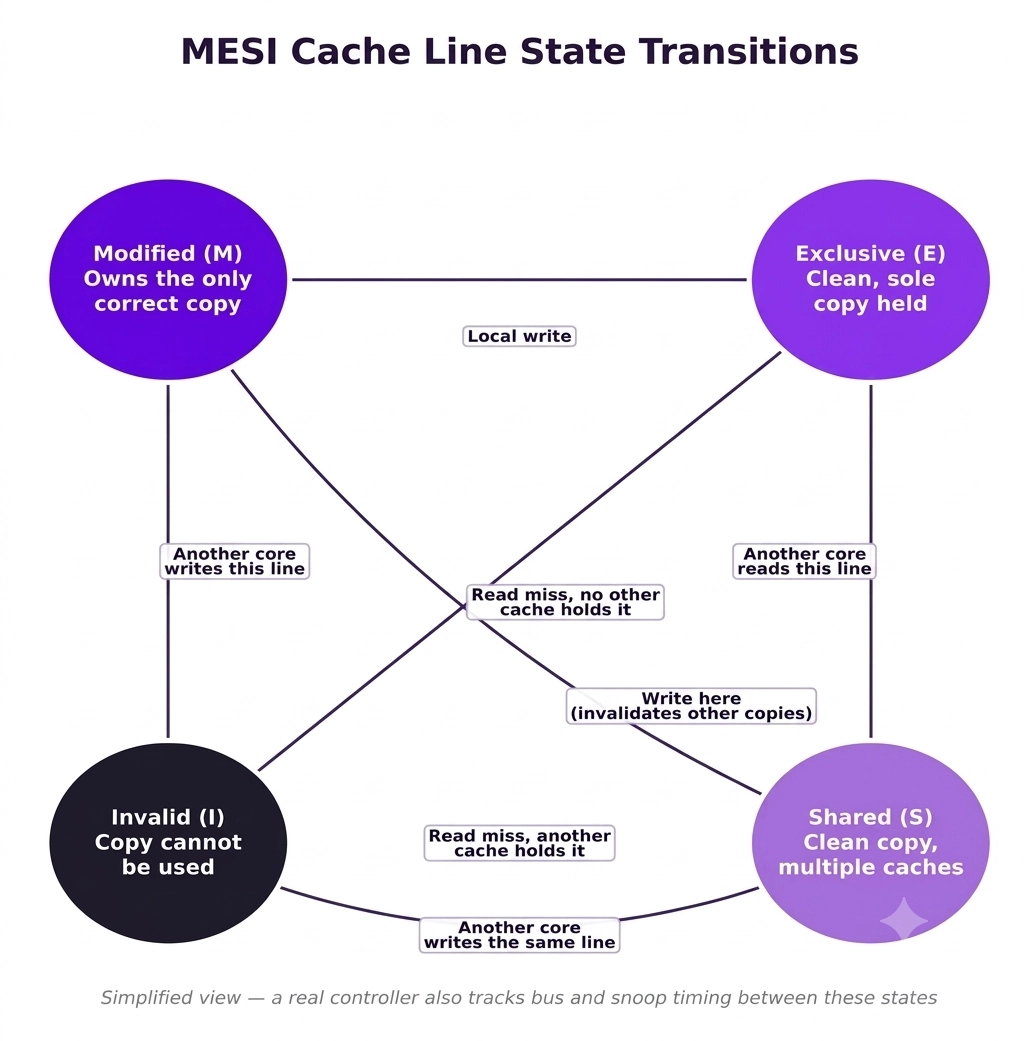
MESI stands for Modified, Exclusive, Shared, and Invalid — the four states a cache line can be in at any point. It’s an invalidate-based coherence protocol developed at the University of Illinois, and it’s the base most commercial write-back cache designs still build on:
- Modified (M): This cache has changed the data, and its copy is the only correct one. Main memory is out of date until this cache writes the value back.
- Exclusive (E): Only one cache holds this line, and it matches main memory exactly. Nothing has been written yet.
- Shared (S): More than one cache holds a clean copy of the same line. All copies match main memory.
- Invalid (I): This cache’s copy can’t be used. Usually this happens because another core just wrote to the same line.
A cache line moves between these four states as cores read and write it, and the protocol’s job is to make those transitions happen at the right time, every time, without ever letting two cores believe they both hold the only correct copy.
Snooping-Based Coherence
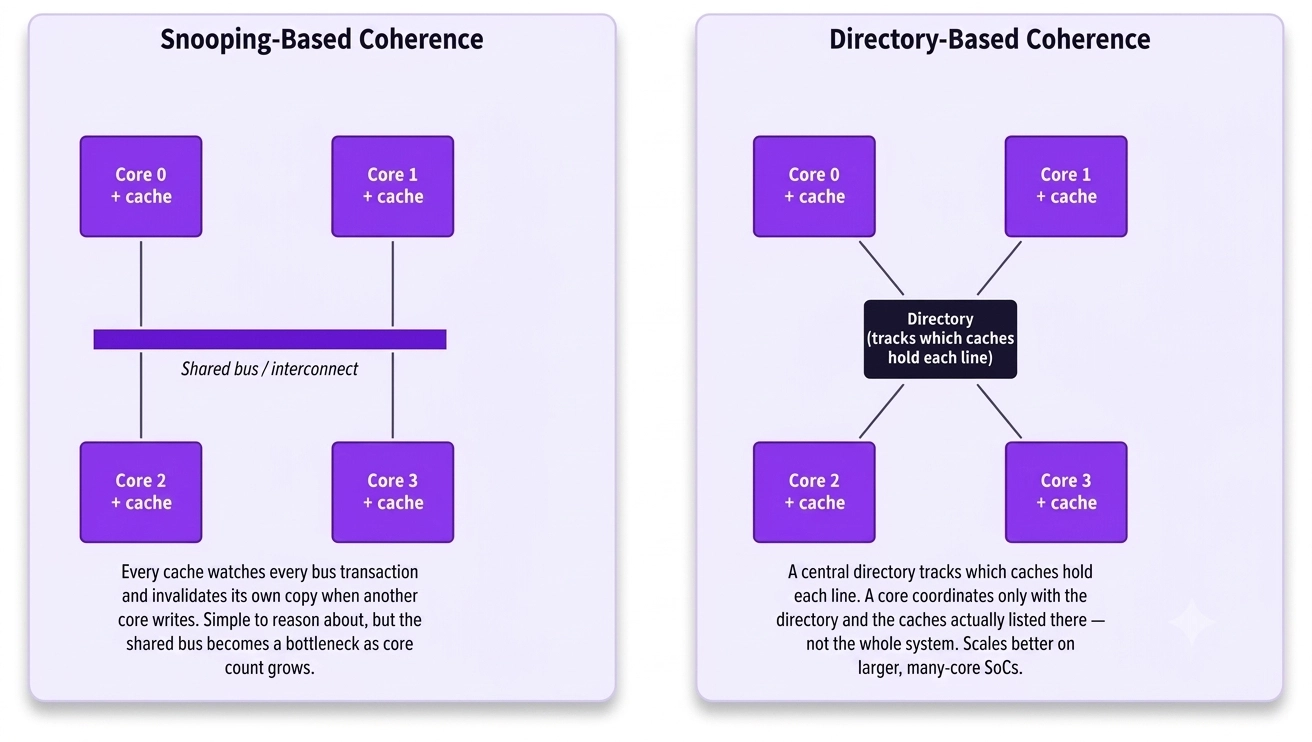
One way to build a coherence protocol is snooping. Every cache watches, or “snoops,” the transactions passing over a shared bus or interconnect. If Core 0 writes to a cache line, the other caches see that transaction and invalidate their own copies right away.
Snooping is simple to reason about and works well in smaller systems, but every cache has to watch every transaction, which doesn’t hold up as the core count grows. Past a certain point, the shared bus itself becomes the bottleneck.
Directory-Based Coherence
Directory-based coherence takes a different approach. Instead of every cache watching every transaction, a central directory keeps a record of which caches hold a copy of each line. When a core needs to write, it only has to coordinate with the directory and the specific caches listed there, not the whole system.
This scales far better on larger multi-core and many-core SoCs, which is why most modern high-core-count designs use a directory-based scheme rather than pure snooping. The trade-off is more design and verification work: the directory itself becomes a piece of shared state that also needs correctness checking.
Graphic 2 — Snooping vs directory-based coherence
Coherence Beyond CPU Cores: Accelerators and Heterogeneous SoCs
Coherence used to be a CPU-only concern. That’s no longer true. Most current SoCs pair CPU cores with GPUs, DSPs, or custom accelerator blocks that also read and write shared memory, and keeping those blocks in sync with the CPU caches is its own design problem.
Interconnect standards such as Arm’s AMBA CHI and ACE extend coherence to these non-CPU agents, letting an accelerator snoop CPU caches or participate in a directory-based scheme the same way a core would. Off-chip, CXL brings a similar idea to memory shared across chips or with attached devices, so a host and a smart NIC or accelerator card can work on the same data without software copying it back and forth.
This matters for verification because a heterogeneous, coherent SoC has more agents that can race with each other, not fewer. A test plan built only around CPU-to-CPU coherence will miss bugs that only appear when an accelerator issues a write while a CPU core holds the line in Shared state. Teams building chips with coherent accelerators need to extend their coherence coverage model to every agent on the interconnect, not just the processor cores, and that’s one of the areas where a general functional-verification background isn’t enough on its own.
Cache Lines and False Sharing
Coherence protocols don’t operate at the level of a single variable. They operate at the level of a cache line, usually 32 or 64 bytes. Read one byte, and the whole line gets pulled into the cache.
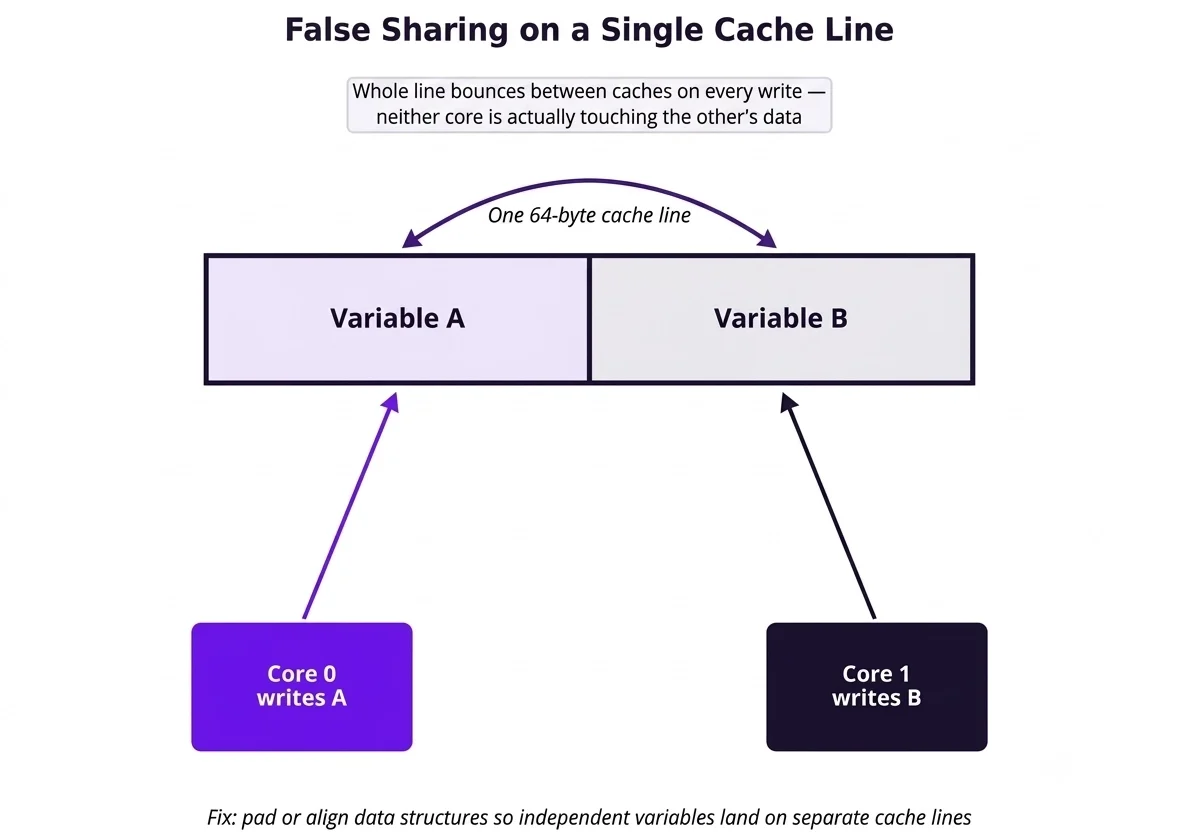
That block-level behavior creates a problem that has nothing to do with a data race in the traditional sense: false sharing. Picture two independent variables, A and B, that happen to sit in the same 64-byte cache line. Core 0 only ever touches A. Core 1 only ever touches B. Neither core is reading or writing the other’s data, but because both variables share one cache line, the coherence protocol treats every write to A as a reason to invalidate Core 1’s copy of the whole line, and every write to B invalidates Core 0’s copy in turn.
Graphic 3 — False sharing on a single cache line
The two cores end up fighting over a cache line neither of them is actually sharing, and the line gets bounced back and forth between caches on every write. Performance drops even though the code is functionally correct. False sharing is a common source of “why is this multi-threaded code slower than expected” bug reports, and it’s a scenario worth including in any coherence-aware performance test, not just a correctness test.
Why Cache Coherence Verification Matters in Multi-Core SoC Design
A coherence protocol that’s correct on paper still has to be proven correct in the actual RTL implementation, and that’s a harder problem than it sounds. The architectural model in a MESI diagram assumes state transitions happen instantly and one at a time. Real hardware doesn’t work that way. With a split-transaction bus or a NoC-based interconnect, requests overlap, responses arrive out of order, and transient states appear between the four “clean” MESI states shown in any textbook. Those transient states are exactly where coherence bugs hide.
This is why cache coherence is treated as its own verification focus area on multi-core processors and SoCs, separate from general functional verification. A design team can pass every unit-level test on the cache controller and still ship a chip that deadlocks under a specific interleaving of simultaneous reads and writes from four or eight cores. Simulation alone struggles to catch these cases, because the number of possible interleavings grows fast as core count goes up, and the failing sequence is often one specific ordering out of millions of legal ones. That’s part of why teams working on coherence-heavy designs increasingly pair simulation with formal property checking on the coherence controller, since a model checker can prove the absence of a race rather than hoping a random test sequence happens to hit it.
What a Cache Coherence Verification Environment Should Test
A coherence verification plan needs to cover a specific set of scenarios, not just a handful of read/write directed tests. At a minimum, it should check:
- Multiple cores reading the same address at the same time
- Multiple cores writing to the same address at the same time
- Read-after-write ordering across cores
- Write-after-read ordering across cores
- Cache-line invalidation, triggered correctly and at the right time
- Cache-line sharing across more than two caches at once
- Evictions and replacements under memory pressure
- Overlapping, simultaneous transactions from different cores
- Snoop responses under contention
- Full state-transition coverage across the coherence protocol, not just the common paths
A simple example makes the intent clear: Core 0 writes A = 100, then Core 1 reads A. The verification environment has to confirm Core 1 gets 100, not a stale value, and it has to confirm that under every timing scenario the protocol allows, not just the easy one. Real coverage plans build on this by adding more cores, back-to-back writes from different cores to the same line, and injected delays that force the protocol into its rarer transient states.
Common Failure Modes When Coherence Verification Gets Cut Short
Coherence bugs that make it past verification tend to follow a pattern. A few show up again and again in post-silicon debug:
- Stale reads under contention. A core reads a value that was already overwritten by another core, usually because an invalidation arrived a cycle too late.
- Deadlock between snoop and local requests. Two cores each wait on a snoop response the other is holding up, and the system locks.
- Missed transient-state coverage. A test suite verifies the four steady MESI states well but skips the in-between states that only appear under specific timing, which is exactly where real bugs live.
- False-sharing performance regressions that get mistaken for a functional bug. The chip is correct, but slow, and the debug time gets spent looking for a bug that isn’t there.
- Directory-protocol edge cases at scale. A directory-based scheme that was verified at four cores runs into new race conditions once the design scales to sixteen or thirty-two.
Every one of these is avoidable with a coherence-specific verification plan built before RTL freeze, not bolted on after a bug shows up in the lab.
How to Assess a Verification Partner for Cache Coherence Work
If you’re bringing in outside help for coherence verification on a multi-core SoC, a few questions separate a team that has actually done this from one that’s learning on your project:
- Have they built coverage models specifically for coherence state transitions, or only for generic read/write functionality?
- Do they use formal property checking on the coherence controller in addition to simulation, especially for directory-based designs?
- Can they show a false-sharing or performance-related test alongside pure correctness tests?
- Do they have a track record with both snooping and directory-based protocols, since the failure modes differ between the two?
- Will they document which transient states were covered and which weren’t, rather than reporting a single pass/fail number?
VLSI design partner with hands-on multi-core verification experience should be able to answer all five without hedging. If you’re weighing options more broadly, our guide to choosing a VLSI design company covers the wider evaluation checklist, and our breakdown of pre-silicon versus post-silicon verification is a useful companion piece if you’re scoping the full verification plan rather than just the coherence portion. If your chip is still early in the flow, the RTL-to-GDSII guide shows where coherence verification sits relative to the rest of the design cycle.
Frequently Asked Questions
What is the difference between cache coherence and cache consistency?
Coherence guarantees that all cores see the correct, up-to-date value for a single memory address. Consistency governs the order in which memory operations across different addresses are observed by different processors. A design can be coherent and still have consistency issues if operations reorder in ways software doesn’t expect.
Is MESI still used in modern processors?
Yes, in some form. Many current processors use MESI or a close variant such as MOESI or MESIF, which add an extra state to reduce unnecessary memory traffic. The core four-state model (Modified, Exclusive, Shared, Invalid) still forms the base of most designs.
Why is verifying cache coherence so hard compared to other RTL blocks?
Because the number of legal interleavings between concurrent reads and writes from multiple cores grows fast as core count increases, and the transient states between clean MESI states are where most bugs hide. Directed tests tend to hit the common paths and miss the rare timing windows, which is why formal verification is used alongside simulation on coherence-heavy blocks.
What is false sharing, and how do you avoid it?
False sharing happens when two cores modify separate variables that happen to sit on the same cache line, causing the coherence protocol to bounce that line between caches even though neither core is touching the other’s data. Padding data structures so independent variables land on separate cache lines is the usual fix.
Does every multi-core chip need a full coherence protocol?
Not always. Some embedded and DSP-style multi-core designs use software-managed coherence or restrict sharing altogether to avoid the hardware cost. Full hardware coherence is standard on general-purpose multi-core CPUs and most application processors, where software can’t be trusted to manage sharing itself.
Should coherence verification use simulation, formal methods, or both?
Both, on any design past a handful of cores. Simulation is good at catching the common paths and building confidence over realistic workloads. Formal property checking is better at proving the absence of specific race conditions and deadlocks in the coherence controller, which is exactly the class of bug simulation is most likely to miss.
Conclusion
Cache coherence keeps a multi-core chip’s caches agreeing on the same data, and MESI-family protocols are the mechanism most designs use to get there through snooping or a directory-based scheme. The basic idea is straightforward: when one core changes shared data, every other core has to stop using its old copy. Proving that holds under every legal ordering of reads, writes, and snoops from multiple cores is the hard part, and it’s why coherence deserves its own verification plan rather than a handful of directed tests bolted onto general functional coverage. As core counts keep climbing, the number of interleavings a verification plan has to account for grows with it, which makes a coherence-specific test strategy, backed by formal methods where it counts, less of an option and more of a requirement.
